A field guide to Inca stonework in Cusco, the Sacred Valley and Machu Picchu: how it was made, why it survived, and where to see it properly.
So, Which Place Is Actually Higher?
I put my palm flat against a wall on Calle Loreto at 7:10 on a cold morning and felt slightly silly. I had read about this wall for years. Standing in front of it, I realized I didn’t know what I was looking at. I was supposed to be impressed. I mostly felt unprepared.
That feeling is common, and it is a good starting point. Most visitors photograph Inca walls without knowing what to check. Once you know, a wall you walked past yesterday becomes the most interesting thing on the street.
Here is a fact that rarely makes it into tour scripts. When the 1950 earthquake hit Cusco, many colonial structures built on top of Inca foundations cracked or collapsed. The Inca walls underneath mostly stayed in place. That is the question this article answers.
Were Inca walls really built without any cement?
Partly. This is the first correction worth making.
Inca builders did not use lime-based cement, but they did use clay and mud mortar in many ordinary buildings. The famous “no mortar” fit applies to the finest imperial masonry, which is only a small share of what the Incas built. Knowing which style you are looking at changes how you read a site.
| Style | What it looks like | Where to see it | Skill level |
|---|---|---|---|
| Pirca (fieldstone) | Rough stones, uneven joints, clay mortar visible | Terrace walls and houses in Pisac and Ollantaytambo | Basic |
| Coursed ashlar | Rectangular blocks in neat horizontal rows | Qorikancha, Temple of the Sun at Machu Picchu | High |
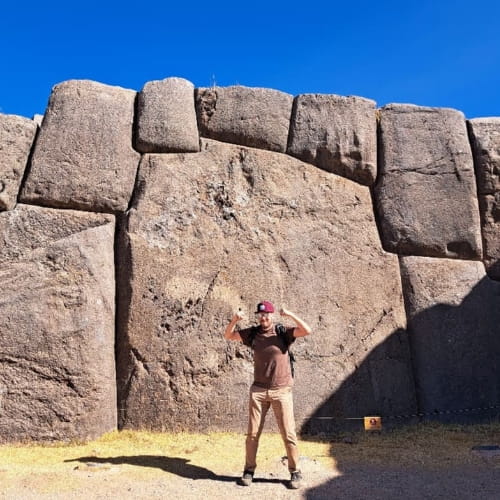
| Polygonal | Irregular multi-angled blocks locked like a puzzle | Calle Hatunrumiyoc, Sacsayhuamán | Very high |
Tip: if you can slide a fingernail into the joint, you are probably looking at pirca. If you cannot, you are looking at imperial work.
How did they shape and fit the stones?
The Incas worked without iron or steel. Stone was shaped with harder stones used as hammers, then refined with abrasion: sand, water and patient grinding. Bronze bars and wooden levers helped with positioning.
The fitting method most researchers describe is trial and error. A block was lowered into place, the contact points were marked, and the block was lifted off and ground down. This was repeated until the two surfaces matched. It explains why the joints on polygonal walls are so tight and why no two stones have the same shape.
Sensory detail to look for: run your eye along a polygonal wall in low light. The faces bulge slightly, and the edges look softly rounded where adjacent stones meet. The surface feels cool and fine-grained, a little like unglazed pottery.
Micro-surprise: on some stones at Ollantaytambo and Machu Picchu you will see small knobs left on the face. They are often interpreted as attachment points for ropes during handling. Some researchers think they were left unfinished, and others think they were decorative. Nobody has settled it.
Why did these walls survive earthquakes?
Cusco sits in an active seismic region, and Inca engineers designed for it. Four features matter:
- Inward-leaning walls. Many walls tilt slightly toward the interior, which lowers the center of gravity.
- Trapezoidal doors and niches. They are wider at the base than at the top, which spreads loads more evenly.
- Interlocking corners. Corner stones are often notched or L-shaped so they hold each other in place.
- Stones that shift and resettle. In a tremor the blocks can move slightly and then settle back, which a rigid, cemented wall cannot do.
Machu Picchu adds another layer. Conservation engineers have estimated that a large part of the construction effort, often put at around 60%, went underground into foundations and drainage rather than the visible walls. A 2019 geological study also argued that the citadel sits at the intersection of fault lines. Treat that as an interpretation rather than a settled fact.
How did they move stones of that size?
There is no single answer, because the quarries differ by site.
| Site | Stone source | Approximate distance | What it tells you |
|---|---|---|---|
| Sacsayhuamán | Mostly local limestone, with some harder stone brought in | Close to the site | The largest blocks are often estimated at over 100 tonnes |
| Cusco city walls | Andesite from Rumiqolqa | About 35 km | Stone was chosen for hardness and color |
| Ollantaytambo Sun Temple | Red porphyry from the Kachiqhata quarry | Several kilometers, across the Urubamba River | Blocks crossed a river and climbed a slope |
The Kachiqhata quarry is the best place to understand the process. Abandoned blocks and a ramp are still visible on the hillside. It shows work that was never finished, which tells you more than a finished wall does.
Personal note: the drive from Cusco to Ollantaytambo covers roughly 70 km and takes about two hours, with stops. I stopped once, looked up at the quarry slope across the valley, and understood the problem immediately. Moving that stone across a river is the hard part of the question.
Where can you see this in Cusco and the Sacred Valley?
Start with the city. These hours are the last published figures and can change, so confirm before you go.
| Place | What to look for | Typical hours | Access |
|---|---|---|---|
| Calle Hatunrumiyoc and Calle Loreto | Polygonal walls, a wall with both sides Inca | Open street, any time | Free |
| Qorikancha (Santo Domingo) | Curved ashlar wall that stayed standing in 1950 | Mon–Sat daytime, shorter hours on Sunday | Included in the full Boleto Turístico, or a separate fee |
| Sacsayhuamán | Zigzag polygonal terraces | About 7:00–17:30 | Boleto Turístico |
| Ollantaytambo | Six red monoliths at the Sun Temple | About 7:00–17:00 | Boleto Turístico |
| Museo de Arte Precolombino (Plaza Nazarenas) | Context for Inca craft and technology | About 8:00–22:00 | Separate ticket |
On the ticket: the full Boleto Turístico costs S/ 130 per person for foreigners, valid for 10 days, while the partial ticket costs S/ 70 and one source notes cash payment in soles. nomades
Recommendation: see Hatunrumiyoc early, before the street fills. Go to Sacsayhuamán in the afternoon, when low sun makes the joints and surface marks easier to read.
Eating and sleeping: for lunch after the walls, Cicciolina (Calle Triunfo) and Chicha (Plaza Regocijo) are both close to the center. For a stay beside Qorikancha, Palacio del Inka sits on the same plaza. Seasonal hours change, so ask about them when you book.
What changed for visitors in 2026?
Machu Picchu’s rules shifted this year, and several details matter if you plan to look at the stonework there.
- Daily capacity. Authorities set a daily limit of 4,500 visitors. During peak periods the cap rises to a maximum of 5,600 per day, and those peak dates include 19 June to 2 November 2026. That means lower capacity returns after 2 November. voyagersfertur-travel
- Advance in-person sales. The regional culture directorate allowed in-person ticket sales at the Machu Picchu Pueblo Cultural Center up to three days in advance, with 1,000 tickets sold this way against 3,500 online. voyagers
- Demand. When 2026 sales opened, tickets for the first five days of January sold out within 12 minutes. fertur-travel
- Inca Trail. Starting in 2026, the Inca Trail permit no longer includes the Machu Picchu entrance ticket, so trekkers need a separate one. tierrasvivas
- Official channel. According to the Ministry of Culture, tickets for all circuits can be purchased only through its official website. andina
- Choquequirao. One travel guide reports the site reopened on April 15, 2026 after trail maintenance. Treat that as unverified until you check it with an operator.
What should you look for inside Machu Picchu?
Most visitors look at the view. For stonework, look at three things:
- The curved wall at the Temple of the Sun. It is the best example of coursed ashlar at the site, with joints so fine they are hard to see.
- The quarry area near the top of the citadel. Cut blocks sit next to unfinished ones, so you can see how stone was prepared on site.
- The terraces. They are structural, not decorative. They hold the slope and move water away from the buildings.
If you are on a timed ticket, check your entry window and route before you arrive, since circuits are now more regulated. Going slowly through the first section tends to work better than rushing to the viewpoint.
When is the best time of year to see Inca walls?
The weather in Cusco is less predictable than guides suggest.
| Months | Conditions | Why it matters for stonework |
|---|---|---|
| April–May | Clearing skies, greener slopes, fewer crowds | Good light, easier timed tickets |
| June–August | Dry, sunny days, freezing nights | Clear photos, but peak capacity and cold mornings |
| September–October | Warmer afternoons, first showers late in the season | Fewer people, variable skies |
| November–March | Rainy season, frequent afternoon storms | Wet stone is slippery, lower capacity at Machu Picchu |
Two details most guides skip:
- The day-night swing. In the dry season, mornings in Cusco can fall below freezing while midday climbs to a comfortable 18–20°C. You will wear and remove layers several times.
- UV. Peru’s national weather service, SENAMHI, regularly issues extreme UV alerts for Cusco, and a cloudy sky does not change that. Wear sun protection on overcast days too.
What should you wear, and where do you buy it in Cusco?
Dress in layers, in the order you will take them off.
| Item | Models and brands travelers commonly use | Why |
|---|---|---|
| Footwear | Salomon X Ultra, Merrell Moab | Grip on wet, polished stone |
| Base layer | Icebreaker merino | Warm without bulk |
| Mid-layer | Patagonia Nano Puff, or alpaca sweaters | Light and packable |
| Rain shell | Marmot PreCip, Patagonia Torrentshell | Afternoon showers |
| Sun protection | Wide-brim hat, Buff | Strong UV at altitude |
Where to look: outdoor shops cluster around Calle Plateros, and alpaca shops are concentrated near Calle Triunfo and the San Blas area. Kuna is a Peruvian alpaca brand with shops in Cusco. Store addresses and stock change, so check them before you rely on a specific shop.
How to buy:
- Read the fiber tag. “Baby alpaca” and “alpaca blend” are different products, and a very low price often means acrylic.
- Check zippers, seams and labels on outdoor brands. Imitations are common in tourist districts.
- Try everything on, and compare two shops before buying.
- Ask about return and exchange policy, since you will use the item immediately.
Practical tips
- Spend your first 24 hours at a slow pace. Cusco is at about 3,400 m.
- Book Machu Picchu tickets first and plan the rest around the entry window.
- Bring cash in soles for tickets and small purchases.
- Allow extra time at Sacsayhuamán. The site is larger than it looks.
- Look at walls early or late. Midday sun flattens the surface detail.
Heading home
The trip back reverses the route: bus down from the citadel, train to Ollantaytambo (about 1.5 hours), then road to Cusco. By then the walls look different. You start to notice the angle of a doorway, the shape of a corner stone, or a bump left on a block. I did not expect that change when I started.
About Travel On Green
Travel On Green is a Cusco-based operator.
- Address: Av. Las Acllas C-7, Cusco
- Email: info@travelongreen.com
- Phone: +51 914 883 792
A note on accuracy: opening hours, prices and capacity rules change often. If a detail in this guide does not match what you find on arrival, or you need current information about a specific site, email us and we will confirm it.